
 Membership
How Lions Are Helping Us Reach Net Zero
From Green Thumbs to Green Paws:
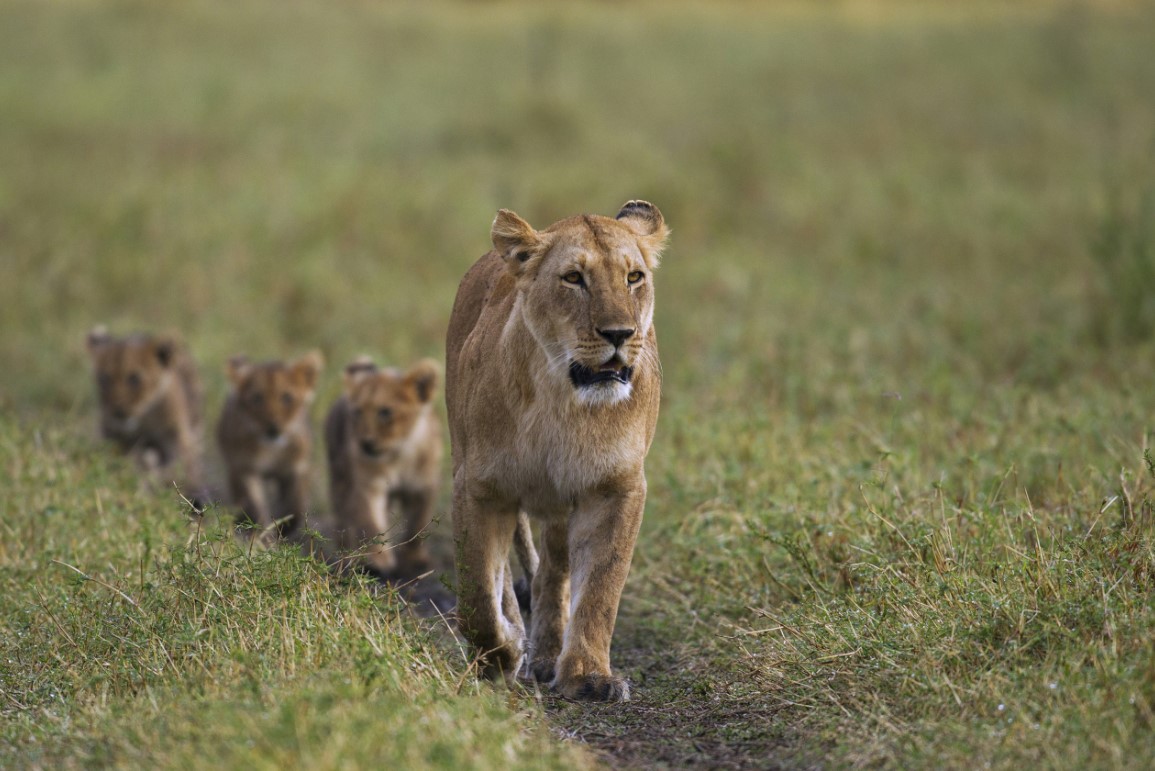 Why settle for just a green thumb when you can have four green paws? Here at the Cincinnati Zoo & Botanical Garden, we have developed the latter (lion paws to be exact). African lions are helping us meet our Net Zero Emissions Goal, ensuring the long-term sustainability of the Zoo’s operations. How exactly are these majestic big cats helping with this, you ask? Our conservation partners at Lion Landscapes have teamed up with Biocarbon Partners (BCP) to form an innovative emissions offset service: Lion Carbon!
The mission of Lion Landscapes is “to make large carnivore conservation valuable to local and global communities.” Lion Landscapes primarily works in southeast Africa, focusing on five large carnivore species: lion, leopard, cheetah, African wild dog, and spotted hyena. They approach conservation by developing community-based solutions, integrating local environmental knowledge into their science-driven conservation efforts.
This collaborative approach is how Lion Landscapes is creating long-lasting coexistence solutions that will benefit the people and wildlife in these diverse landscapes.
Biocarbon Partners (BCP) is a for-profit company that follows REDD+ conservation methods, a mechanism designed by the United Nations Framework Convention on Climate Change to mitigate emissions from destruction of forests. The mission of BCP is to “develop award-winning forest carbon offset projects in areas of global biodiversity significance to conserve Africa’s wildlife legacy landscapes while delivering life changing community impacts under REDD+.” Forests in southern Africa are facing pressure from local communities due to agriculture, charcoal production, and logging demands, and the resulting deforestation releases carbon stored in the trees. BCP is working to shift the communities’ mindsets away from generating income through deforestation to generating income through conservation.
With the REDD+ projects, local communities can generate revenue through the sale of carbon emissions offsets. BCP’s process starts and ends with the communities local to the protected forests. Local buy-in is important, and BCP works with local leaders to decide which forest to protect under their project structure. Once the forest has been selected, BCP calculates emissions reductions as a result of conservation by estimating the amount of greenhouse gases that would be released due to deforestation. Using the Verified Carbon Standard (Verra) verification process, BCP is issued Verified Carbon Units (VCU) emissions offsets, which can then be sold.

The profits from the sale of these offsets go back to the communities that the project works with. When the BCP projects begin, a board of locally elected community members is formed to determine where the protected forest will be. The same board is in charge of managing the revenue from the sale of VCUs derived from their local project. The revenue is then used for social service development projects such as access to clean water, health clinics, schools, as well as livelihood initiatives, including beekeeping, banking, and agriculture.
The Cincinnati Zoo is proud to support this program that empowers communities to self-govern how the funds are used in alignment with conservation goals.
Lion Carbon combines the best of both worlds: human-wildlife coexistence and emissions offset credits. In this collaboration, Lion Landscapes contributes to project development and biodiversity monitoring while BCP focuses on the management of forest protection projects, such as the Lower Zambezi REDD+ Project and the Luangwa Community Forests Project.
As a result of these projects, Lion Carbon produces Verified Carbon Units (VCU) that can be purchased by institutions looking to offset their total emissions while also contributing to big cat conservation.

Since the BCP Lower Zambezi REDD+ project began, lions have returned to the protected area, ten years after their last sighting. Additionally, BCP supports 240 Community Scouts and Honorary Forest Officers at the Zambian REDD+ projects. The most recent graduating class of 105 students included 14 women. These Scouts complete an intensive four-month training program held by the Department of National Parks and Wildlife in Zambia. It is important for BCP to support this program because the Scouts patrol the protected forests, prevent wildlife poaching, and collect data that is vital to conservation efforts.
By choosing to purchase offsets from Lion Carbon, institutions are directly contributing to the development of sustainable livelihoods, access to basic services and resources, securing and protecting forest and wildlife, and supporting high level biodiversity monitoring.
“This training changed my perspective on nature and taught me the value of teamwork, endurance, and the critical role we play in fostering harmony between humans and the environment.
A huge thank you to BCP staff and partners for their continuous support in building the next generation of conservation heroes. Zikomo Kwambiri!”– Rosaria Chanda, BCP-supported Community Scout Graduate.
Read more about BCP-supported Community Scout Graduates here

The VCU credits that Lion Carbon produces are where the Cincinnati Zoo comes in. This year, as a part of developing a non-traditional offset portfolio to reach Net Zero Emissions, the Zoo has purchased VCUs from Lion Carbon. The decision to buy offsets from Lion Carbon stems from the Zoo’s desire to make a positive impact through our purchasing decisions. Unlike traditional emissions credits that can be purchased through large energy companies, the VCUs purchased from Lion Carbon both offset emissions and support wildlife conservation.

Through purchasing emissions offsets from Lion Carbon, the Cincinnati Zoo is supporting big cat conservation efforts, reducing global carbon emissions, and improving the livelihoods of communities coexisting with wildlife in southeast Africa. It is our hope here at the Zoo that other organizations will follow in our tracks and develop green paws, too.